
Digital Marketing Strategy for Small Businesses in 2026 (Step-by-Step)
Digital marketing strategy for small businesses in 2026 isn’t about doing everything. It’s about choosing the few channels your customers actually use, building a conversion-ready foundation, and creating content that both people and search engines (including AI answers) can trust [4].
This guide is built for small teams and real budgets. You’ll get a simple framework, a practical channel plan, a budget split, and a 30-day execution checklist.
Quick answer: what is a digital marketing strategy?
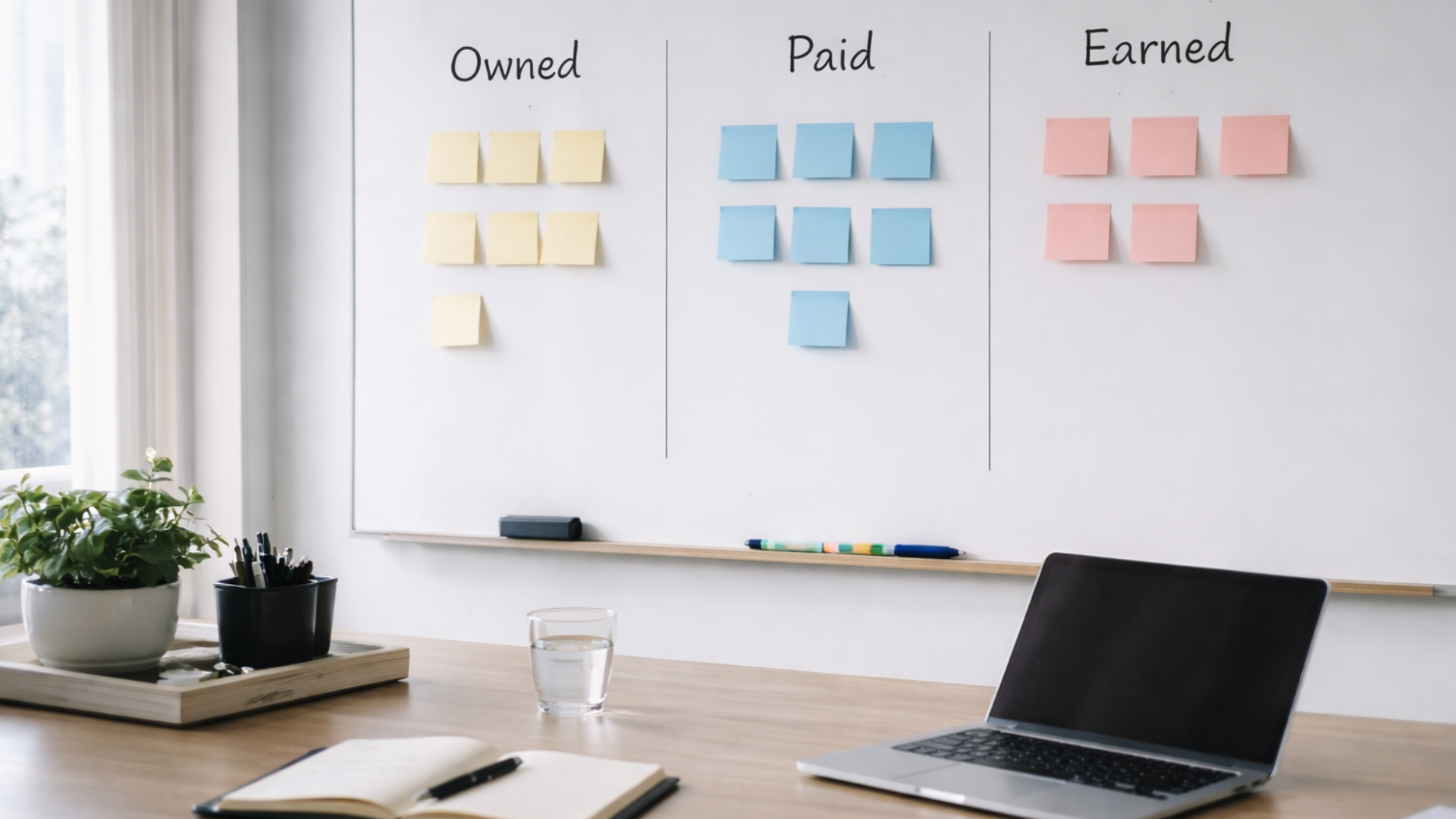
A digital marketing strategy is a plan for how you’ll attract attention online, turn that attention into leads or sales, and measure what’s working by using a mix of owned (your website/content), paid (ads), and earned (reviews/mentions/shares) channels [1].
Why 2026 strategy feels different for small businesses
- Competition keeps rising: global digital advertising spend is projected to keep growing through 2026 [2].
- AI is shaping discovery: marketers are increasing AI usage for productivity and personalization, which changes the “content + distribution” playbook [5].
- Google is rewarding people-first content: quality, trust, and usefulness matter more than “SEO tricks” [3].
The UXFocus framework: Foundations → Demand Capture → Amplification
Most small businesses waste budget by amplifying too early (ads/social) before the foundation is ready. Here’s the order we recommend:
1) Foundations (website + offer + tracking)
- One clear offer and one clear “next step” (call, form, booking).
- Fast, mobile-friendly pages and a clean user journey (no clutter).
- Conversion tracking (forms, calls, bookings) so you can make decisions with data.
If your foundation isn’t solid, every marketing channel becomes more expensive.
UXFocus note: If you want this done-for-you, start with our Website Development services and build from a conversion-ready base.
2) Demand Capture (SEO + AEO + local proof)
In 2026, the best “free traffic” still comes from intent-based search—especially local searches and problem-based queries. The key is publishing helpful content designed to genuinely answer questions [3].
- Build 1 pillar page per core service (e.g., “digital marketing solutions”).
- Publish weekly support articles that answer one question each.
- Add an FAQ section to improve answer visibility and AI readability.
- Collect reviews/testimonials and keep business info consistent across platforms.
UXFocus note: Explore our Digital Marketing solutions if you want SEO, content, and paid strategy connected under one system.
3) Amplification (ads + social distribution)
Once your site converts and your messaging is clear, you can use paid media and social content to scale. Your goal isn’t “more traffic.” It’s more qualified traffic.
- Paid search: capture high-intent buyers (“near me”, “pricing”, “best”).
- Retargeting: re-engage people who visited but didn’t convert.
- Short-form content: turn one article into multiple posts for distribution.
Channel plan for small businesses (simple, not overwhelming)
If you’re starting or rebuilding in 2026, this channel mix is realistic:
- Website + landing pages (foundation)
- SEO/AEO content (compounding growth)
- Email (follow-up + retention)
- One “primary” social platform (distribution, not dependency)
- Paid search (when you need predictable leads)
A practical budget split (starter-friendly)
There’s no universal “perfect” number, but small businesses usually get the best ROI by splitting effort like this:
- 40% Foundations (website improvements, landing pages, tracking)
- 30% Demand Capture (SEO/AEO content, local optimization)
- 20% Amplification (ads + retargeting)
- 10% Experiments (new creatives, new offers, new channels)
Why this matters: digital ad competition is rising overall, so improving conversion rates and owned channels protects your margins [2].
30-day execution plan (what to do first)
Week 1: Fix the foundation
- Clarify offer + ideal customer + top 3 objections.
- Improve homepage + 1 service page + 1 landing page.
- Set up conversion tracking (forms, calls, bookings).
Week 2: Publish demand-capture content
- Write 2 articles answering real customer questions.
- Add an FAQ block to each article to improve answer visibility [3].
- Internally link to your service page and your contact/booking page.
Week 3: Launch one paid channel
- Start with high-intent search ads (pricing, location, service keywords).
- Create 2–3 ad variations and one focused landing page.
- Measure cost per lead and lead quality (not just clicks).
Week 4: Add retention + automation
- Set up an email follow-up sequence for new leads.
- Repurpose your best article into 5 social posts.
- Review data weekly and adjust.
Common mistakes small businesses should avoid
- Running ads to a weak page (low trust, unclear offer, no proof).
- Posting daily on social with no measurement or strategy.
- Publishing content for algorithms instead of people [3].
- Ignoring AI workflows that speed up production (while keeping quality high) [5].
FAQs
What’s the best digital marketing channel for small businesses?
The best channel is the one that matches buyer intent. For many small businesses, that’s a mix of a strong website, local SEO, and a focused paid search campaign—supported by email follow-up.
How long does SEO take to work?
Most businesses see early movement in weeks, but meaningful results typically take a few months. The compounding effect comes from consistent publishing and improving usefulness over time [3].
Is AI replacing marketing teams?
For most small businesses, AI is best used to speed up research, drafts, variants, and reporting—while humans protect positioning, voice, proof, and ethics [5].
Next step
If you want a strategy that turns into leads (not just content), UXFocus can build the foundation, publish the content, and scale what works across Digital Marketing, Website Development, and Graphic Design.
Book a quick strategy call and we’ll map the simplest path to your next 90 days of growth.
Sources
- [1] BDC — Digital marketing definition and overview: https://www.bdc.ca/en/articles-tools/entrepreneur-toolkit/templates-business-guides/glossary/digital-marketing
- [2] Oberlo — Global digital ad spend forecasts: https://www.oberlo.com/statistics/digital-ad-spend
- [3] Google Search Central — Creating helpful, reliable, people-first content: https://developers.google.com/search/docs/fundamentals/creating-helpful-content
- [4] Google Search Central — Guidance about AI-generated content: https://developers.google.com/search/blog/2023/02/google-search-and-ai-content
- [5] HubSpot — Marketing stats & AI adoption signals: https://www.hubspot.com/marketing-statistics