
Start here Websites and Apps
Enterprise Data Architecture: Why Closed SaaS Stacks Are a Technical Debt Bomb

In the modern enterprise landscape, a dangerous illusion has taken root: the belief that renting your core business infrastructure from closed-source Software-as-a-Service (SaaS) platforms is a shortcut to scaling.
It isn’t. It is a high-interest technical debt loan masked as convenience.
Whether it is your marketing ecosystem, your customer data engine, or your lead ingestion pipelines, anchoring your enterprise to a closed corporate sandbox creates a structural vulnerability. Your customer histories, operational logic, and proprietary data structures become deeply entangled in black-box code.
When your business scales to the point where you must inevitably migrate, you are not looking at a quick technical facelift. You are looking at a high-risk, deeply volatile data extraction surgery. If you want to leverage predictive AI modeling, build unyielding automation workflows, and maintain true data ownership, you must build on an open-source framework from day one. You need unmitigated control over your raw database pipes to feed the machine.
The Fragility of Unmanaged Open-Source Stacks

To be entirely fair, open-source architectures (specifically ecosystems like WordPress) frequently get a bad reputation among enterprise engineers. But let’s analyze the root cause of that skepticism: unmanaged technical debt.
When inexperienced developers treat a core framework like a house of cards, stacking unverified third-party packages and plugins indiscriminately, a single dependency shift can trigger a devastating domino effect. One outdated library update can cascade into endless debugging loops and catastrophic development overhead.
Mature engineering teams don’t play games with fragmented dependency trees. They utilize clean code, native server-side database routing, and hardened, heavily audited open-source engines to deliver a scalable, sovereign digital asset.
Minimizing the Perimeter: Gravity Forms as an Enterprise Ingestion Engine
At a strategic operational level, an enterprise web infrastructure exists to accomplish two fundamental goals: process secure transactions or capture high-quality leads for a fulfillment team. Instead of routing those operations through a fragmented web of disparate third-party software applications, elite architects rely on Gravity Forms within a managed WordPress ecosystem to act as a unified data ingestion engine. Because it has anchored millions of global deployments since 2008, it provides a bulletproof framework to execute complex operations completely under one roof.
By structuring your infrastructure around a mature open engine, you fundamentally alter the economics of your tech stack for both sides of the aisle:
| Stakeholder | What They Gain | What They Eliminate |
| Business Owners | • A high-valuation, sovereign data asset. • Absolute control over infrastructure limits. | • Third-party middleware reliance. • Unpredictable, recurring SaaS subscription taxes. |
| Developers | • Total programmatic control via native PHP hooks. • Low-latency server-level APIs. | • Relentless security liabilities of auditing custom file uploads. • Unstable state validations and breaking external payloads. |
Deep Dive: Architectural Execution of Native Workflows
By keeping your data pipeline native, you can deploy advanced operational mechanics that would cost thousands of dollars per month to replicate inside a closed software bundle.
1. Eliminating the 70% Lead Leak (Partial Entries)

Industry data proves that up to 70% of high-intent users who initiate a web form abandon the process midway. In a standard SaaS environment, those leads evaporate.
By utilizing native Partial Entries, the exact fraction of a second a prospective client types their email address into the primary field, the server securely caches the keystroke in real time. Even if the user drops Wi-Fi, experiences a browser crash, or closes the tab, the lead is captured. The data can be instantly routed to your CRM to initiate an automated recovery sequence, frequently doubling conversion rates overnight without a single dollar of additional marketing spend.
2. Eradicating the E-Signature SaaS Tax

Relying on external subscription platforms like DocuSign or Adobe PDF’s just to execute standard client onboarding agreements is a massive operational drain.
By pairing an enterprise signature engine with front-end dynamic calculation fields, the entire contract lifecycle stays native. The client inputs their project boundaries, the system mathematically calculates the pricing string in real time, and they sign a legally binding document directly on the screen. Upon submission, the server automatically generates an airtight PDF contract, handles the cryptographic audit trail, and issues the initial invoice via Stripe. It will execute the entire lifecycle with zero external subscription software fees.
3. Bypassing the Middleware Time Bomb
Relying on external brokers like Zapier or Make to pass form data to your CRM is an operational risk. If a marketing campaign goes viral, every single submission triggers multi-hop automated tasks. Your middleware bill spikes exponentially overnight, or worse, you hit a hard account ceiling and your entire sales pipeline freezes.
With direct server-side hooks and native API webhooks, data is selectively and instantly routed at the server level. The system passes data cleanly to suites like HubSpot or an internal database with zero latency, complete protection from breaking third-party API mutations, and zero “per-task” processing costs.
The AI “Vibe Coding” Illusion

We are living in an era where industry leaders are heavily hyping automated development. But there is a terrifying, structural chasm between prompt-driven “Vibe Coding” and true enterprise data architecture.
Generative AI models are magnificent accelerators for writing cosmetic front-end layout code or generating quick visual templates. However, an AI cannot architect structural integrity. It has no innate comprehension of server-side state validation, it cannot map compliant database schemas, and it cannot safely defend your data perimeter.
Elite engineering teams don’t use artificial intelligence to replace underlying systems; they use it to write custom logic faster inside mature, heavily hardened, open-source frameworks. You cannot allow a hallucinating model to own your security perimeter.
The Strategic Reality Check
Let us be completely transparent: running a high-performing open enterprise stack is not without its trade-offs. It is a Ferrari and you do not buy a Ferrari if you are only planning to drive it through a school zone.
If all your enterprise requires is a basic, static three-field contact page, deploying an advanced data framework like this is severe engineering overkill. Furthermore, because this stack is built strictly for extreme database routing and data security, the styling is highly utilitarian out of the box; achieving a hyper-modern, elite brand aesthetic requires custom CSS or a deeply competent engineering hand.
How we can help
If you want this kind of architecture without managing hooks, licences and custom styling yourself, we can plan and build it with you, on hosting you own. No platform is 100% secure, so the plan includes ongoing updates, backups and monitoring.
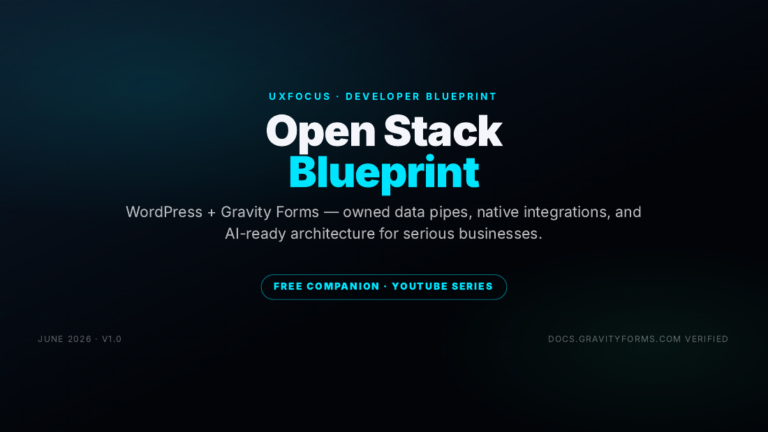 PDF · 19 pages
Free developer blueprint
Get the Open Stack Blueprint
Prefer to build it yourself? The Open Stack Blueprint is our reference guide for WordPress and Gravity Forms: architecture layers, partial entries, CRM patterns and security basics.
- Reference architecture for owned lead and payment pipes
- Partial-entry to CRM patterns that match the Gravity Forms docs
- Security perimeter guidance for personal data and AI readiness
We email you the PDF and add you to our contacts so we can follow up. No spam, unsubscribe any time. Privacy policy
Published by UXFocus
A digital marketing agency located in Toronto and the GTA. We build the website, the campaigns and the follow-up as one system, and every guide links to the official source behind its advice.