
Free founder checklist
Zero Trust Checklist for founders
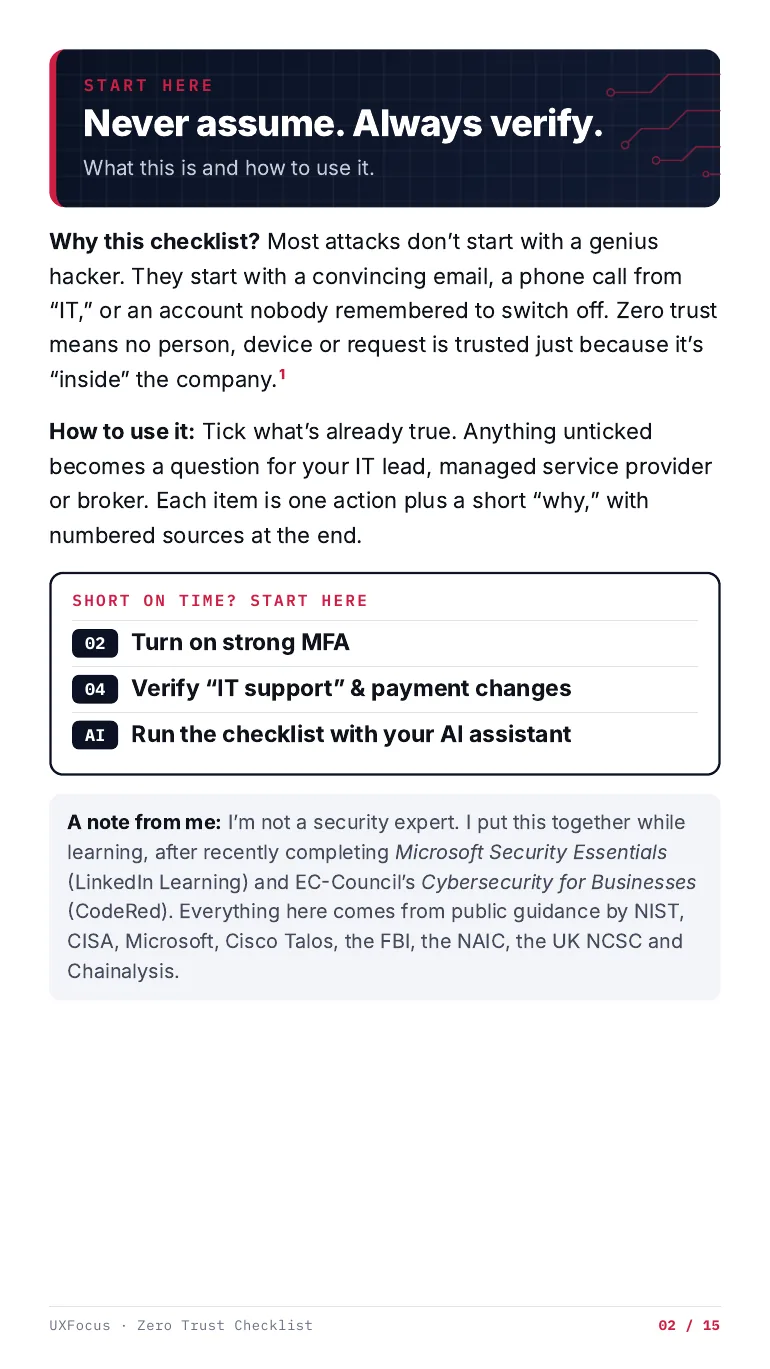
Never assume. Always verify. A plain-English checklist for founders and small business owners who aren’t security specialists. Ask better questions, close common gaps, and get your tech and team ready.
- 8sections
- 34checks
- 19public sources
Enter your name and email and we’ll send the checklist. You’ll also get an instant download on this page.
We use your name and email to send you this checklist — as a download on this page, and as a copy by email. Your details are stored in our CRM (HubSpot). We won’t sell your information. See our privacy policy.

What’s inside
Each item is one action plus a short “why,” with numbered sources at the end. Tick what’s already true. Anything unticked becomes a question for your IT lead, managed service provider or broker.
Short on time? Start with strong MFA, then with how you verify “IT support” calls and payment changes, or run the list with your AI assistant.
- 8 sections and 34 practical checks, each with a short “why”
- Drawn from 19 public sources, including NIST, CISA, Microsoft and the UK NCSC
- A copy-paste prompt so your AI assistant can walk you through the list
- Questions to take to your IT lead, provider and insurance broker
- Written in plain English, for people who aren’t security specialists
-
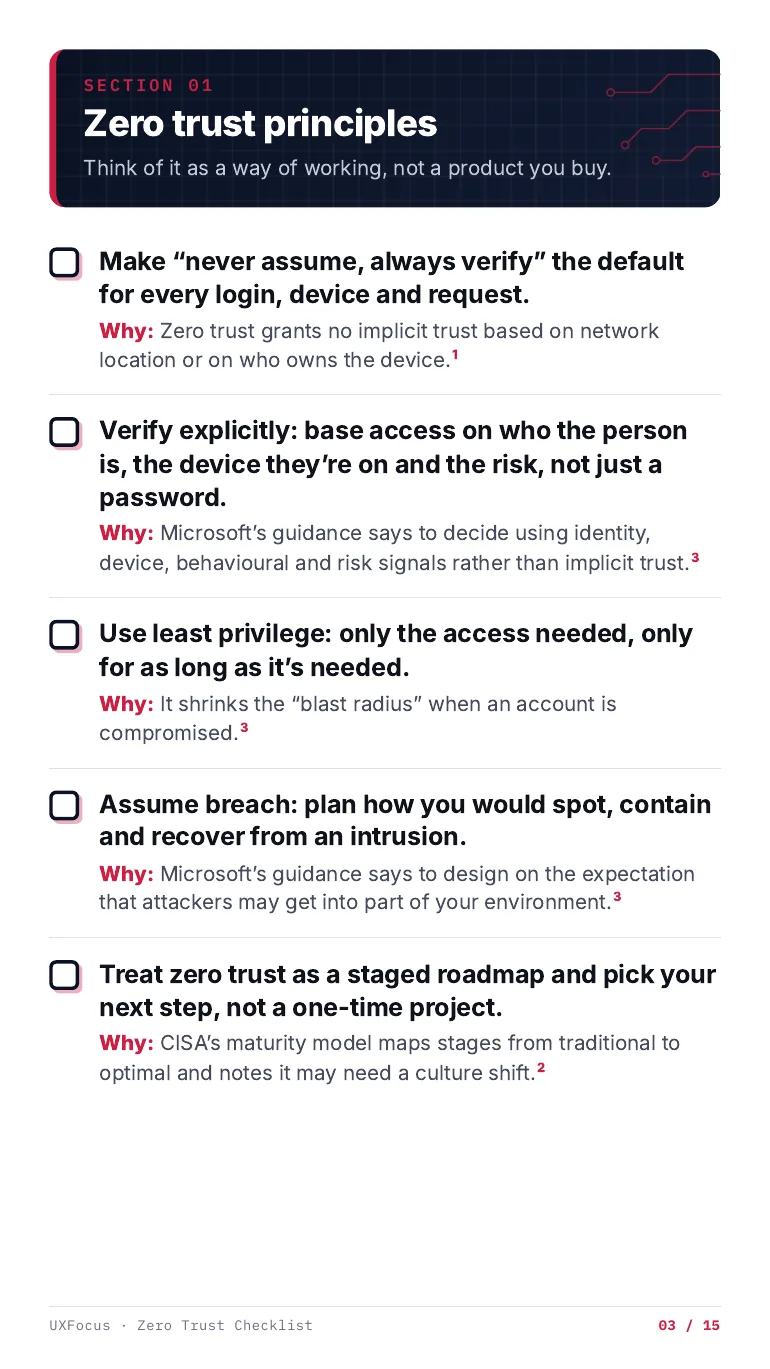
1. Zero trust principles
Think of it as a way of working, not a product you buy.
5 checks -
2. Multi-factor authentication (MFA)
A password alone isn’t enough. Phishing-resistant MFA is the goal.
4 checks -
3. Least-privilege access and regular reviews
Only the access that’s needed, only for as long as it’s needed.
4 checks -
4. Verify support requests and payment changes
Treat unexpected “IT support” messages and payment-detail changes as unverified until you check them through a channel you already trust.
4 checks -
5. Lock down cloud tools and ad accounts
MFA, least privilege, consent reviews and a clean offboarding step for every cloud, social and ad login.
4 checks -
6. Treat security as risk management
Inventory, patching, backups, and a written response plan, framed with NIST CSF 2.0.
6 checks -
7. Understand your cyber insurance
Questions to bring to your broker, with answers in writing.
4 checks -
8. Stay current: AI phishing and the quantum horizon
New tricks, same basics.
3 checks
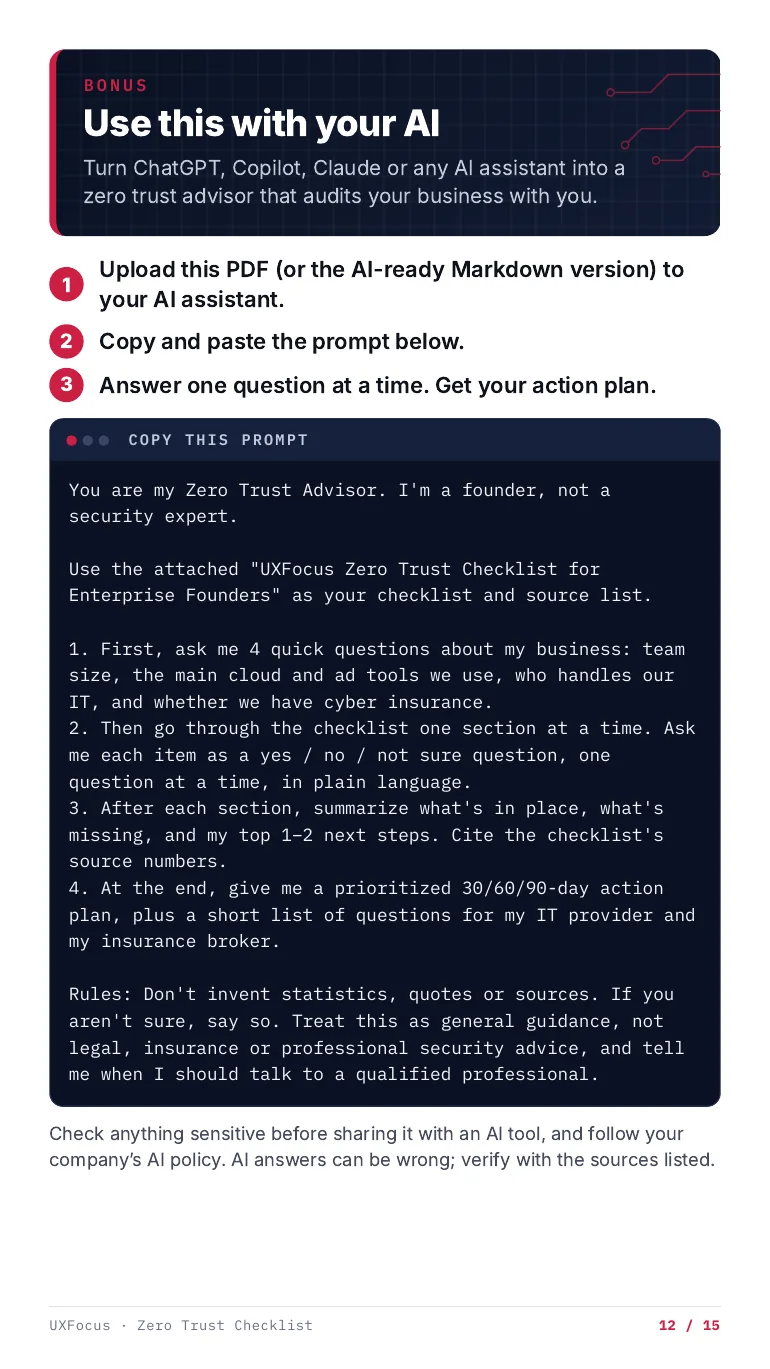
Use this with your AI.
A copy-paste prompt you can give ChatGPT, Copilot, Claude or another assistant, so it can walk you through the checklist and help you shape a 30/60/90-day plan. Upload the PDF, or the AI-ready Markdown version, and paste the prompt. Check anything sensitive before you share it with an AI tool.
Why it matters
Most attacks don’t start with a genius hacker. They start with a convincing email, a phone call from “IT,” or an account nobody remembered to switch off. Zero trust means no person, device or request is trusted just because it’s “inside” the company.
A few public figures help set the scene, without overstating them:
In 2025, ransomware actors received more than US$820 million in on-chain payments, even as claimed attacks rose 50%, according to Chainalysis.
In a 2022 ISACA survey of more than 3,000 consumers in the UK, Australia, the US and India, 33% said they had stopped doing business with a company known to have experienced a breach.
This checklist won’t make those risks disappear. It will help you see what’s already in place, and what to ask next.
Who it’s for
- Founders and small business owners who aren’t security specialists
- Executives who want clearer questions for their IT lead, managed service provider or insurance broker
- Anyone treating zero trust as a staged way of working, not a product to buy once
What it isn’t
This checklist is general information for educational purposes. It is not legal, insurance, compliance or professional cybersecurity advice, and it doesn’t guarantee protection against any attack. Check decisions with qualified security, legal and insurance professionals.
A note from Sanjeevan
I’m not a security expert. I put this together while learning, after completing Microsoft Security Essentials (LinkedIn Learning) and EC-Council’s Cybersecurity for Businesses (CodeRed). Everything here comes from public guidance by NIST, CISA, Microsoft, Cisco Talos, the FBI, the NAIC, the UK NCSC and Chainalysis. Always learning.

Want help getting your tech and team ready?
Reach out to UXFocus.
We build websites, apps and marketing systems, and we’re happy to help you work through this checklist alongside your IT and security partners.
Book a discovery callThis checklist is general information for educational purposes. It is not legal, insurance, compliance or professional cybersecurity advice, and it doesn’t guarantee protection against any attack. Check decisions with qualified security, legal and insurance professionals. The author is not a certified security professional. Statistics and recommendations belong to the sources cited, as of 19 November 2026. Product and company names are used for reference only.
© 2026 UXFocus Inc. · uxfocus.marketing · Privacy policy